ISSN: 2349-6002
 An UGC-Compliant International Research Journal

How to Publish a Research Paper for PhD, M.Tech & MBA Students in 2026 - Complete Step-by-Step Guide
If you're a PhD scholar, M.Tech student, or MBA researcher in 2026, publishing a research paper isn't just a checkbox on your academic to-do list — it's the single biggest investment you can make in your degree, your career, and your future earning potential. A published paper unlocks thesis approval, qualifies you for assistant professor jobs, strengthens your NET-JRF profile, opens doors to PhD admissions abroad, and builds the academic credibility that employers and universities actually look for.
But here's the truth most guides won't tell you: the publishing process is different for PhD, M.Tech, and MBA students — and using the wrong approach can cost you months of delay or outright rejection.
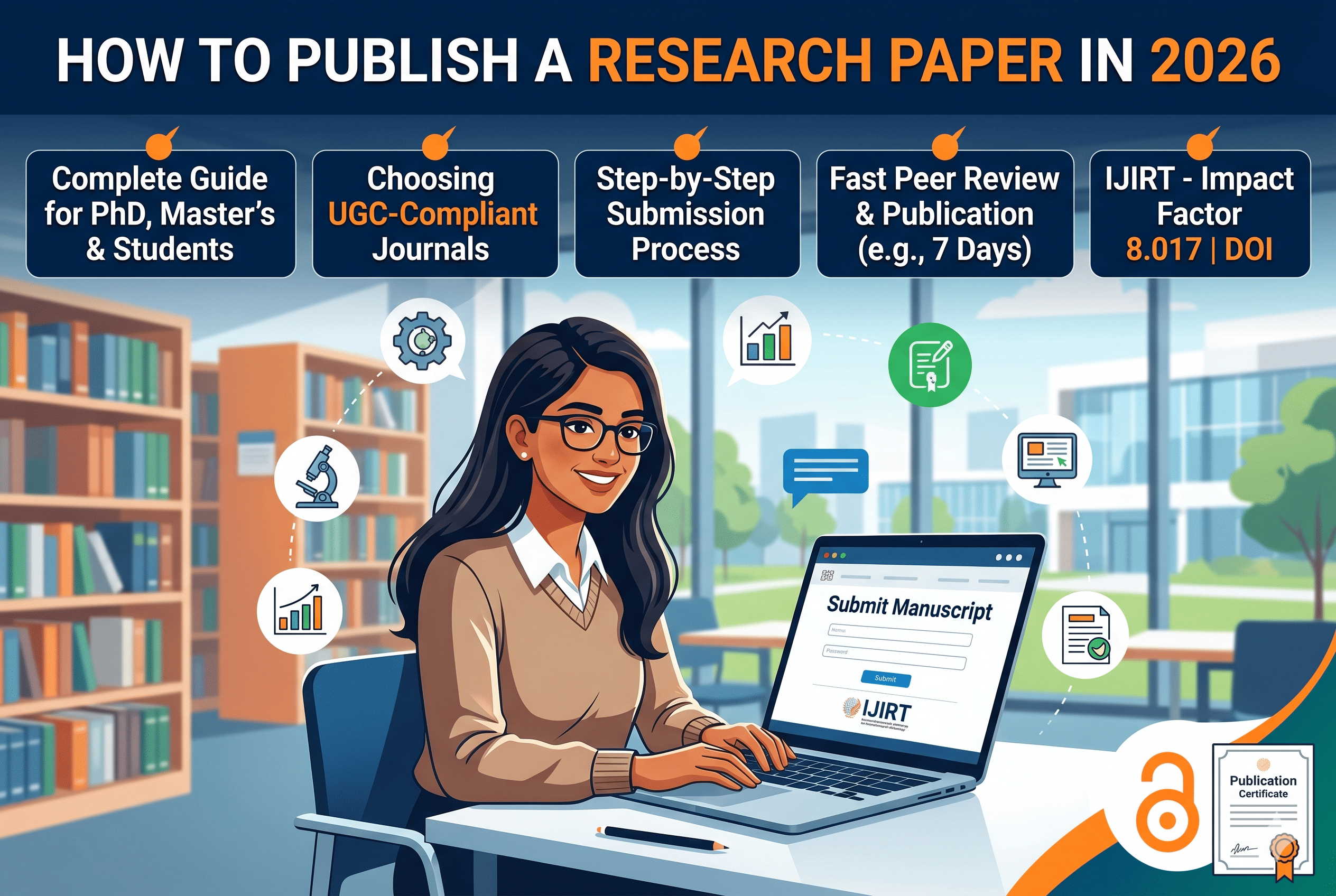
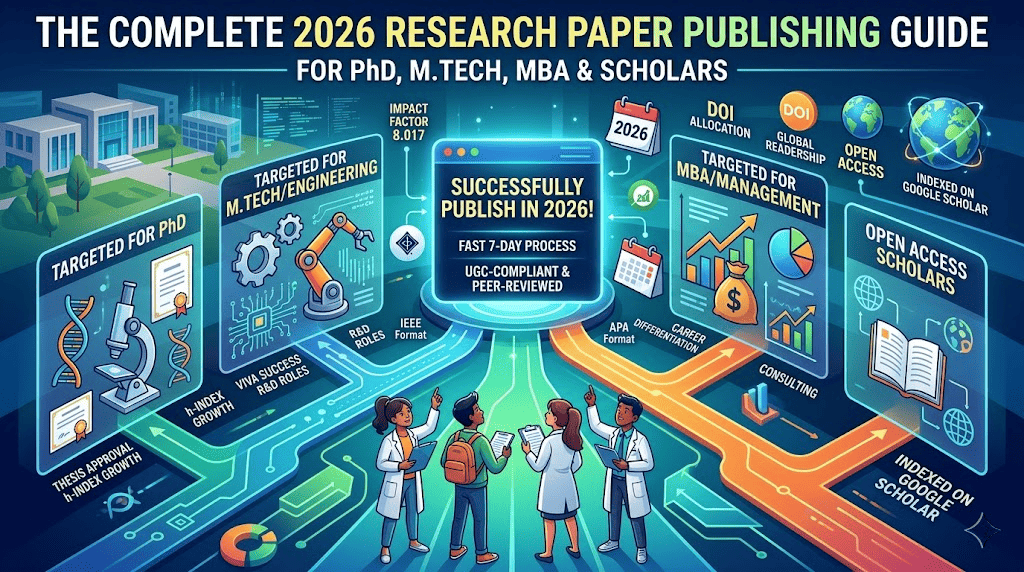
This complete 2026 guide breaks down exactly how to publish a research paper based on your degree, your stream, and your timeline — and how IJIRT (International Journal of Innovative Research in Technology), a UGC-compliant peer-reviewed journal with an Impact Factor of 8.017, can get your paper published in as little as 7 working days.
👉 In a hurry? Submit Your Research Paper to IJIRT Now — Get Published in 7 Days →
Why Every PhD, M.Tech & MBA Student Must Publish a Research Paper in 2026
Before we get into the "how," let's quickly cover the "why" — because understanding the stakes will help you take this process seriously.
For PhD Scholars
The University Grants Commission (UGC) mandates at least one to two publications in peer-reviewed journals before PhD thesis submission. Without published papers, you cannot:
- Submit your synopsis or thesis for evaluation
- Appear for your pre-submission seminar
- Apply for postdoctoral fellowships in India or abroad
- Qualify for assistant professor positions or UGC-NET exemption
- Build a strong h-index for academic career advancement
For M.Tech Students
While not always mandatory, most engineering colleges and IITs/NITs now require M.Tech students to publish their thesis findings in a peer-reviewed journal as part of the dissertation evaluation. A published paper:
- Strengthens your final viva voce defence
- Becomes a permanent credential on your CV
- Boosts your chances for PhD admissions in India and overseas
- Improves placement opportunities in R&D roles at companies like ISRO, DRDO, TCS Research, and Infosys Labs
For MBA Students
MBA scholars — especially those in Tier-1 B-schools, dual-specialisation programs, and Executive MBA — are increasingly required to publish a management research paper as part of their dissertation or capstone project. A published MBA paper:
- Differentiates you in competitive placement pools
- Opens consulting, research, and analytics career tracks
- Qualifies you for FPM (Fellow Program in Management) admissions at IIMs
- Builds thought leadership for future entrepreneurship or academia
What's Different About Publishing as a PhD, M.Tech, or MBA Student?
Each degree comes with its own publishing expectations. Here's the quick-reference breakdown:
| Aspect | PhD Scholar | M.Tech Student | MBA Student |
|---|---|---|---|
| Paper type | Original research / review | Thesis-based research | Empirical or conceptual study |
| Length | 6,000–10,000 words | 4,000–7,000 words | 3,500–6,000 words |
| Methodology | Mandatory, in-depth | Required, applied | Quantitative or qualitative |
| References | 40+ citations | 20–30 citations | 15–25 citations |
| Plagiarism limit | Under 10% | Under 15% | Under 15% |
| Co-author allowed | Yes (with guide) | Yes (with supervisor) | Yes (with faculty mentor) |
| Indexing needed | UGC-CARE / Scopus | UGC-Compliant peer-reviewed | UGC-Compliant peer-reviewed |
The good news? IJIRT accepts all three types of papers under a single, simplified submission process — with stream-specific reviewers and fast turnaround for every category.
Step-by-Step Guide: How to Publish Your Research Paper in 2026
Here's the exact roadmap from "first draft" to "published paper with DOI" — applicable to PhD, M.Tech, and MBA scholars alike.
Step 1: Choose the Right Research Topic
Pick a topic that is specific, original, and aligned with current academic trends in 2026.
- PhD scholars: focus on a research gap identified in your literature review
- M.Tech students: extend your thesis problem statement into a publishable finding
- MBA students: combine industry data with academic frameworks (SWOT, Porter's, etc.)
Avoid overly broad topics like "Impact of AI on Society" — go specific, like "Impact of Generative AI on Marketing ROI in Indian D2C Brands."
Step 2: Structure Your Manuscript Correctly
A standard research paper for IJIRT includes:
- Title — clear, keyword-rich, under 15 words
- Author details — names, affiliations, email IDs
- Abstract — 150–250 words summarising problem, method, findings
- Keywords — 4 to 6 relevant terms (e.g., "machine learning, supply chain, MBA, predictive analytics")
- Introduction — background, problem statement, objectives
- Literature Review — what others have done, what's missing
- Methodology — your research design, tools, data sources
- Results & Discussion — findings with charts/tables/analysis
- Conclusion — key takeaways, limitations, future scope
- References — IEEE for engineering, APA for management/MBA
Step 3: Run a Strict Plagiarism Check
In 2026, journal acceptance is increasingly tied to plagiarism scores. Use:
- Turnitin (gold standard for PhD)
- DrillBit (UGC-recommended)
- Grammarly Premium / Quetext (for budget-conscious M.Tech and MBA students)
Aim for under 10% similarity for PhD papers and under 15% for M.Tech / MBA. IJIRT's editorial team will run a final plagiarism check, so don't try shortcuts — they cost you the submission.
Step 4: Format the Paper as Per Journal Template
Download the IJIRT manuscript template before submission. Common formatting requirements:
- Font: Times New Roman, 10 pt
- Line spacing: single
- Margins: 1 inch on all sides
- Section headings: bold, numbered (1, 1.1, 1.2…)
- Figures and tables: numbered with captions
- References: consistent style throughout
A correctly formatted paper signals professionalism and dramatically speeds up review.
Step 5: Choose a UGC-Compliant Peer-Reviewed Journal
This is where most students lose months. Avoid these red flags:
- ❌ Journals demanding payment before review
- ❌ "Guaranteed publication in 24 hours" promises
- ❌ No editorial board listed
- ❌ Suspicious or missing ISSN
- ❌ No DOI or indexing details
Choose a journal that is:
- ✅ UGC-compliant or UGC-CARE listed
- ✅ Peer-reviewed with a transparent process
- ✅ Indexed in Google Scholar and recognised databases
- ✅ Has a verifiable Impact Factor
- ✅ Provides DOI on request
IJIRT meets every one of these criteria.
Step 6: Submit Online and Track Your Paper
Submit your manuscript via the IJIRT submission portal. You'll receive:
- A unique Paper ID within minutes
- Confirmation email within 24 hours
- Reviewer decision within 2 to 5 working days
Step 7: Respond to Reviewer Comments
If reviewers suggest revisions:
- Address each comment point-by-point in a separate response letter
- Highlight changes in your revised manuscript
- Don't argue — even if you disagree, explain politely
- Resubmit within the deadline
Step 8: Pay Publication Charges & Submit Forms
Once accepted:
- Pay nominal article processing charges (APC) as per acceptance email
- Submit the signed copyright form and undertaking
- Provide author details for the publication certificate
Step 9: Get Published, Cite & Share
After payment and form submission:
- Your paper goes live on ijirt.org within 3–7 working days
- You receive a publication certificate (for every author)
- You get a permanent URL and DOI on request
- Share the link on LinkedIn, ResearchGate, Google Scholar, and your CV
How to Publish a PhD Research Paper in 2026 — Special Tips
PhD publication is the most rigorous of the three. Here's what works in 2026:
- Co-author with your guide — UGC strongly encourages this; it adds credibility and speeds up review
- Target UGC-CARE listed journals — required for most Indian universities
- Aim for 2–3 publications during PhD — one early (literature review), one mid (methodology paper), one late (findings)
- Include original data and primary research — review-only papers are harder to get accepted
- Build a publication portfolio — quantity and quality both matter for your academic CV
IJIRT publishes PhD-quality original research across all disciplines and provides expert peer-review feedback that strengthens your thesis defence.
How to Publish an M.Tech Research Paper in 2026 — Special Tips
M.Tech publication is usually thesis-based. Here's how to convert your dissertation into a publishable paper:
- Don't submit your full thesis — extract the most novel chapter (usually results + methodology)
- Co-author with your supervisor — mandatory in most engineering colleges
- Add experimental data, simulations, or code — IJIRT highly values reproducible engineering research
- Use IEEE reference format — standard for technical papers
- Submit before your viva — a published paper massively improves your defence and final grade
IJIRT publishes M.Tech research across Civil, Mechanical, Electrical, Computer Science, IT, Electronics, AI, ML, IoT, Robotics, and every other engineering stream.
How to Publish an MBA Research Paper in 2026 — Special Tips
MBA papers are often empirical or industry-focused. Here's the 2026 playbook:
- Use real industry data — primary surveys, secondary data from RBI / SEBI / industry reports
- Combine quantitative + qualitative methods — strengthens findings
- Apply established frameworks — SWOT, PESTLE, Porter's Five Forces, BCG Matrix, Balanced Scorecard
- Use APA citation format — standard for management research
- Focus on practical implications — what should managers actually do based on your findings?
IJIRT welcomes MBA research papers in Marketing, Finance, HR, Operations, Business Analytics, Supply Chain, Strategy, Entrepreneurship, Digital Marketing, and Fintech.
How Long Does It Take to Publish in IJIRT?
Here's why thousands of PhD, M.Tech, and MBA students choose IJIRT in 2026:
- Submission to confirmation: within 24 hours
- Peer-review decision: 2 to 5 working days
- Acceptance to live publication: 3 to 7 working days
- Total time from submission to published paper: usually under 10 days
Compare this with traditional journals (6–18 months) and you'll understand why deadline-driven scholars trust IJIRT.
What You Get When You Publish in IJIRT
Every accepted paper in IJIRT comes with:
- ✅ Publication certificate for every co-author
- ✅ Soft copy of the published paper
- ✅ Permanent URL on ijirt.org
- ✅ DOI on request
- ✅ Indexing on Google Scholar and academic databases
- ✅ Hard copy option for thesis and viva submission
- ✅ Reviewer feedback to strengthen future research
- ✅ UGC-compliant credentials usable for thesis, jobs, and promotions
Common Mistakes PhD, M.Tech & MBA Students Make While Publishing
Avoid these costly errors that cause 80% of paper rejections:
- Submitting without proofreading — typos and grammar errors trigger instant rejection
- Ignoring journal scope — a marketing paper won't get published in a mechanical engineering journal
- High plagiarism scores — anything above 15% is auto-rejected
- Weak abstracts — your abstract is read first; if it's poor, the paper is dead
- No clear research contribution — reviewers ask: "What's new here?"
- Falling for predatory journals — non-UGC, no peer review, fake impact factor
- Skipping the literature review — shows lack of academic depth
- Missing deadlines for revisions — most journals reject papers if revisions aren't submitted on time
Why IJIRT Is the Best Choice for PhD, M.Tech & MBA Students in 2026
Here's a complete comparison snapshot:
| Feature | IJIRT in 2026 |
|---|---|
| Journal Type | UGC-Compliant, Peer-Reviewed |
| Impact Factor | 8.417 |
| Disciplines Accepted | Engineering, Management, Science, Pharmacy, Humanities, Computer Science |
| Review Time | 2–5 working days |
| Publication Frequency | Monthly |
| Open Access | Yes — global free readership |
| DOI | Available on request |
| Indexing | Google Scholar + academic databases |
| Certificate | Yes, for every co-author |
| Suitable For | PhD, M.Tech, MBA, M.Sc., MCA, M.Pharm, B.Tech final year |
| Editorial Support | [email protected] |
Frequently Asked Questions
Q1. Can M.Tech students publish in IJIRT before completing their thesis? Yes. Many M.Tech students publish their interim findings or methodology papers before final thesis submission. It strengthens the viva and final dissertation grade.
Q2. Is IJIRT suitable for PhD scholars in 2026? Absolutely. IJIRT is UGC-compliant, peer-reviewed, and widely accepted by Indian universities for PhD synopsis, thesis submission, and academic CV building.
Q3. Can MBA students publish management or marketing research in IJIRT? Yes. IJIRT actively publishes MBA research across marketing, HR, finance, analytics, supply chain, and entrepreneurship.
Q4. Can I publish jointly with my guide, supervisor, or faculty mentor? Yes. Co-authorship with your guide is encouraged and adds credibility to the publication.
Q5. How much does it cost to publish in IJIRT? IJIRT keeps article processing charges among the most affordable in the industry. Exact charges are shared in your acceptance email.
Q6. Will my IJIRT paper be accepted for thesis and job applications? Yes. IJIRT publications are UGC-compliant and accepted for PhD synopsis, thesis submission, NET-JRF profile, assistant professor jobs, and academic promotions.
Q7. Can B.Tech and undergraduate students also publish in IJIRT? Yes. IJIRT welcomes papers from B.Tech, B.Sc., BBA, and BCA students — especially final-year project work and research-based mini-thesis papers.
Ready to Publish Your Research Paper in 2026?
Whether you're a PhD scholar racing against your synopsis deadline, an M.Tech student preparing for viva, or an MBA researcher building your career portfolio — IJIRT gives you the fastest, most credible, and most affordable path to publication.
Stop waiting. Stop second-guessing. Get your research published, certified, and globally readable in under 10 days.
👉 Submit Your Research Paper to IJIRT Now — Get Published in 7 Days →
Need help choosing the right approach for your paper? Email the IJIRT editorial team at [email protected] and our experts will guide you personally.